
More Information
Submitted: January 09, 2026 | Accepted: January 20, 2026 | Published: January 21, 2026
Citation: Mamad A, Bibat MA, Elafari MA, Maachi Y, Slaoui A, Karmouni T, et al. Penile Fracture: The “Cracking” Sound and Intra-operative Tunica Albuginea Repair. J Clin Med Exp Images. 2026; 10(1): 001-002. Available from:
https://dx.doi.org/10.29328/journal.jcmei.1001038.
DOI: 10.29328/journal.jcmei.1001038
Copyright license: © 2026 Mamad A, et al. This is an open access article distributed under the Creative Commons Attribution License, which permits unrestricted use, distribution, and reproduction in any medium, provided the original work is properly cited.
Keywords: Penile fracture; Cracking sound; Tunica albuginea; Urological emergency

Penile Fracture: The “Cracking” Sound and Intra-operative Tunica Albuginea Repair
Ayoub Mamad*, Mohammed Amine Bibat, Mohammed Amine Elafari, Youssef Maachi, Amine Slaoui, Tarik Karmouni, Abdelatif Koutani and Khalid Elkhader
Urology B Department, IBN Sina Hospital, University Hospital Center IBN SINA, University Mohammed V, Rabat, Morocco
*Corresponding author: Ayoub Mamad, Urology B Department, Ibn Sina Hospital, University Hospital Center IBN SINA, University Mohammed V, Rabat, Morocco, Email: [email protected]
Penile fracture is a rare urological emergency typically characterized by an audible “cracking” sound, immediate detumescence, and rapid penile swelling following trauma to an erect penis. We present clinical and intra-operative images of a 37-year-old man with a proximal tunica albuginea tear confirmed at urgent exploration and repaired with absorbable sutures. Early surgical exploration with hematoma evacuation and primary repair remains the preferred approach to reduce long-term complications such as penile curvature and erectile dysfunction.
Penile fracture is an uncommon urological emergency caused by rupture of the tunica albuginea of the corpora cavernosa, most often during sexual intercourse [1]. Population-based emergency department data suggest a rare incidence [2]. The injury typically results from sudden bending of an erect penis with an audible “cracking” sound, immediate detumescence, and rapid swelling/deformity [1].
A 37-year-old man presented with sudden penile pain and rapid swelling that occurred during sexual intercourse, immediately preceded by an audible “cracking” sound and followed by abrupt detumescence. On examination, there was marked penile shaft swelling with mild angulation/deviation, highly suggestive of penile fracture (Figure A). There was no hematuria.
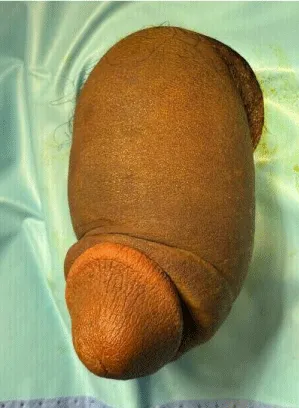
Figure A: Preoperative photograph showing marked penile swelling with mild angulation/deviation following sexual intercourse, consistent with penile fracture.
Penile ultrasonography demonstrated a penile hematoma. Although imaging can be helpful in selected cases, the combination of the typical mechanism, the reported cracking sound with immediate detumescence, and the characteristic clinical appearance supported the diagnosis on clinical grounds, and urgent surgical exploration was indicated. The patient was taken to the operating room and explored via a circumferential subcoronal incision with complete penile degloving (Figure B). After evacuation of the hematoma, a tear of the tunica albuginea was identified at the penile root (proximal corpora cavernosa) and repaired with three separate interrupted absorbable sutures (3‑0 Vicryl) (Figure C). No urethral injury was identified.
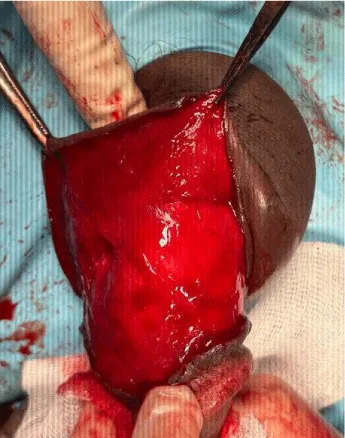
Figure B: Intra-operative photograph after circumferential subcoronal incision and complete penile degloving.

Figure C: After hematoma evacuation, the proximal corporal tunica albuginea tear at the penile root is identified (blue arrow) before repair with interrupted 3-0 Vicryl sutures.
Postoperative recovery was uneventful. At 1-month follow-up, the surgical site demonstrated satisfactory healing (Figure D). After discharge, the patient was prescribed erection-suppressing medical therapy to minimize postoperative erections during the early healing period.
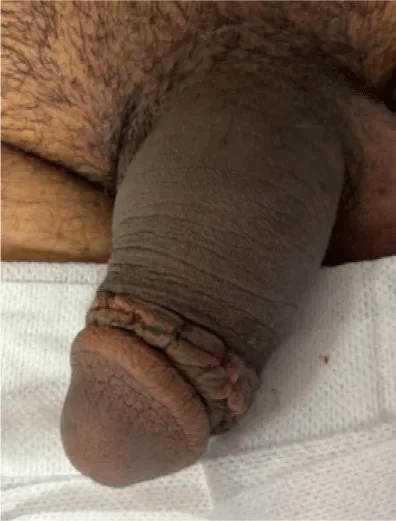
Figure D: Postoperative appearance at 1 month showing satisfactory healing.
Penile fracture most commonly results from sudden bending (“buckling”) of an erect penis, leading to rupture of the tunica albuginea and rapid hematoma formation. When the classic history is present - particularly an audible “cracking” sound followed by immediate detumescence with rapid swelling/deformity - the diagnosis is often clinical, and imaging should not delay management in typical presentations [1,3]. Ultrasonography may be useful in selected or equivocal cases to support diagnosis and aid surgical planning [3].
Early surgical exploration with hematoma evacuation and primary tunica albuginea repair remains the preferred management strategy and is associated with lower rates of long-term complications such as penile curvature and erectile dysfunction compared with conservative management [1,3-5]. Although the early outcome was favorable in this patient, standard follow-up objectives include assessment for penile curvature and erectile function; accordingly, follow-up is planned beyond the 1-month visit (e.g., at 6–8 weeks and 3–6 months) to evaluate functional recovery and late sequelae [1,3-5].
This clinical image highlights the classic presentation of penile fracture and demonstrates intra-operative identification and primary repair of a proximal tunica albuginea tear. Early surgical exploration with hematoma evacuation and tunica albuginea repair remains the preferred approach to minimize long-term complications such as penile curvature and erectile dysfunction [1,3-5].
Patient consent: Written informed consent for publication of the clinical details and images was obtained from the patient.
- Falcone M, Garaffa G, Castiglione F, Ralph DJ. Current management of penile fracture: an up-to-date systematic review. Sex Med Rev. 2018;6(2):253–260. Available from: https://doi.org/10.1016/j.sxmr.2017.07.009
- AL-Mamari SA. Epidemiology of penile injury. In: Urogenital Trauma: A Practical Guide. Springer; 2023. p. 305–306. Available from: https://link.springer.com/chapter/10.1007/978-981-99-6171-9_36
- Kitrey ND, Djakovic N, Hallscheidt P, Kuehhas FE, Lumen N, Serafetinidis E. EAU guidelines on urological trauma. Arnhem (Netherlands): EAU Guidelines Office; 2022.
- Amer T, Wilson R, Chlosta P, AlBuheissi S, Qazi H, Fraser M, et al. Penile fracture: a meta-analysis. 2016. Available from: https://doi.org/10.1159/000444884
- Koifman L, Barros R, Junior RAS, Cavalcanti AG, Favorito LA. Penile fracture: diagnosis, treatment and outcomes of 150 patients. Urology. 2010;76(6):1488–1492. Available from: https://doi.org/10.1016/j.urology.2010.05.043